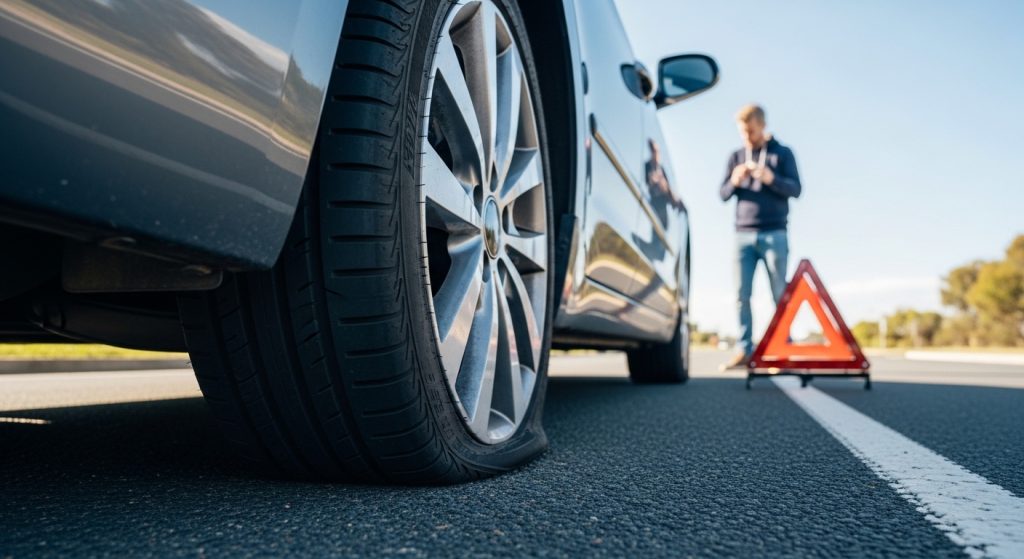
A flat tyre occurs when your tyre loses most or all of its air pressure, making it unsafe to drive. This can happen due to common road hazards such as nails, screws, or broken glass, as well as issues like a damaged valve stem, bead leak, or sidewall cut. When tyre pressure drops too low, the tyre can no longer support your vehicle properly, and driving on it can lead to serious and costly damage.
If you get a flat tyre in Perth, the first step is to safely pull over, turn on your hazard lights, and stop driving immediately unless it’s absolutely necessary. Driving on a flat tyre can damage the tyre’s internal structure, ruin your wheel rim, and negatively affect your vehicle’s suspension, steering, and alignment.
Don’t worry — many flat tyre problems can be fixed quickly if handled the right way.
In this guide, you’ll learn what to do when you have a flat tyre, whether it’s safe to drive on one, how run-flat tyres work, when a tyre should be repaired or replaced, how to change a tyre safely, how to prevent flat tyres in the future, and how to find fast, reliable tyre service in Perth when you need it most.
Let’s get started.
What to Do If You Have a Flat Tyre: Quick 8-Step Checklist
Whether you’re dealing with flat tyres in Perth traffic, a punctured tyre in a shopping centre car park, or a flatty car in your driveway, acting calmly and methodically prevents further damage – and unnecessary costs.
Here’s exactly what to do.
8 Immediate Steps to Follow If You Have a Flat Tyre
- Slow down gradually and pull over somewhere safe, away from traffic.
- Turn on your hazard lights immediately to alert other drivers.
- Apply the handbrake and switch off the engine.
- Engage wheel chocks or turn wheels away from traffic if parked on a slope.
- Inspect the tyre visually — check for sidewall damage, nails, or total deflation.
- Do NOT drive on a severely deflated flat tyre, as this can destroy the tyre and damage your rims.
- Use your spare tyre if safe and confident to do so, or use a repair kit if appropriate.
- Call a professional mobile tyre service in Perth. Wangara Tyre & Auto can assist quickly in Wangara, Landsdale, Wanneroo and surrounding suburbs.
Now that you know what to do immediately, the next big question most drivers ask is: Can you actually drive on a flat tyre – even for a short distance? Let’s answer that clearly.
Can You Drive on a Flat Tyre?
No, you should not drive on a flat tyre. Driving on a flat tyre will destroy the internal structure of the tyre. It can seriously damage the tyre, wheel rim, suspension, steering components, and alignment. It may lead to loss of vehicle control.
However, in limited situations, you may move the vehicle a very short distance at very low speed (for example, to safely clear traffic). Beyond that, continued driving is unsafe.
Can You Drive with a Punctured Tyre?
A puncture is when a foreign object penetrates the tyre and lets air escape. Not every puncture becomes a flat immediately, and not every flat is caused by a puncture.
If you wonder whether you can drive with a punctured tyre or not; it depends.
- If the tyre is losing air rapidly, do not continue driving.
- If pressure is only slightly reduced, you may cautiously move to a safe stopping location.
Professional inspection is required before driving further. Even minor punctures can weaken the tyre structure internally.
What About Run Flat Tyres?
If your vehicle has run flat tyres, the situation changes slightly.
Run flat tyres are specially reinforced tyres designed to temporarily support the vehicle’s weight even after losing air pressure. Most run flat tyres allow you to drive:
- Up to 80 kilometres
- At a maximum speed of 80 km/h
This gives you enough time to reach a tyre repairer without changing the tyre roadside. However, continuing to drive beyond recommended limits can make the tyre unrepairable.
What if a run flat tyre is punctured?
- Reduce speed immediately to under 80 km/h
- Do not exceed approximately 80 km of travel
- If you’re more than 80 km from a repairer, call roadside assistance
For a detailed comparison, read our guide to run flat tyres vs regular tyre.
Spare Tyre or Repair Kit – Which Should You Use?
When you have a flat tyre, you typically have three options:
- Fit a full-size spare tyre
- Use a temporary space-saver spare
- Use a tyre repair kit (sealant + compressor)
Each has pros and limitations.
Using a Spare Tyre
✔ Maintains normal driving performance
✔ Safer for longer distances
✔ No major speed restriction
Space-Saver Spare (Temporary Use Only)
✔ Lightweight
✔ Easy to install
❌ Speed usually limited to 80 km/h
❌ Short-term use only
A spare tyre is ideal if you’re confident changing it and parked safely.
Using a Tyre Repair Kit
Repair kits inject sealant into the tyre to temporarily plug small tread punctures.
✔ Quick and convenient
✔ No need to remove wheel
✔ Useful in emergencies
But:
❌ Not suitable for sidewall damage
❌ Not effective for large punctures
❌ Often only temporary
❌ May complicate professional repair
If the damage is more than a small tread puncture, a repair kit won’t solve the issue.
Repair vs Replace: How to Decide If a Flat Tyre Can Be Fixed
Most small punctures in the central tread can be repaired. Sidewall or shoulder damage, large holes, exposed cords, excessive wear or internal damage means replace. Always let a trained technician inspect the tyre before deciding.
Here’s your quick decision guide:
Situation | Repair? | Replace? | Why |
Small tread puncture ≤ 6 mm (central tread) | ✔ | ❌ | Repairable if within central 60–70% of tread and no internal damage. |
Puncture in shoulder or sidewall | ❌ | ✔ | Sidewall flexing makes repairs unsafe. |
Puncture > 6 mm | ❌ | ✔ | Large holes compromise structure; replacement required. |
Run-flat tyre with bead/bubble/internal damage | ❌ / depends | ✔ | Many RFTs are non-repairable unless manufacturer marks “repairable RFT.” |
Multiple prior repairs (close together) | ❌ | ✔ | Safety rules limit number/spacing of repairs; too many weaken the tyre. |
Tread below legal limit (1.5 mm) | ❌ | ✔ | Tyres at or under the legal minimum must be replaced. |
How to Change a Flat Tyre: 11 Quick & Safe Steps
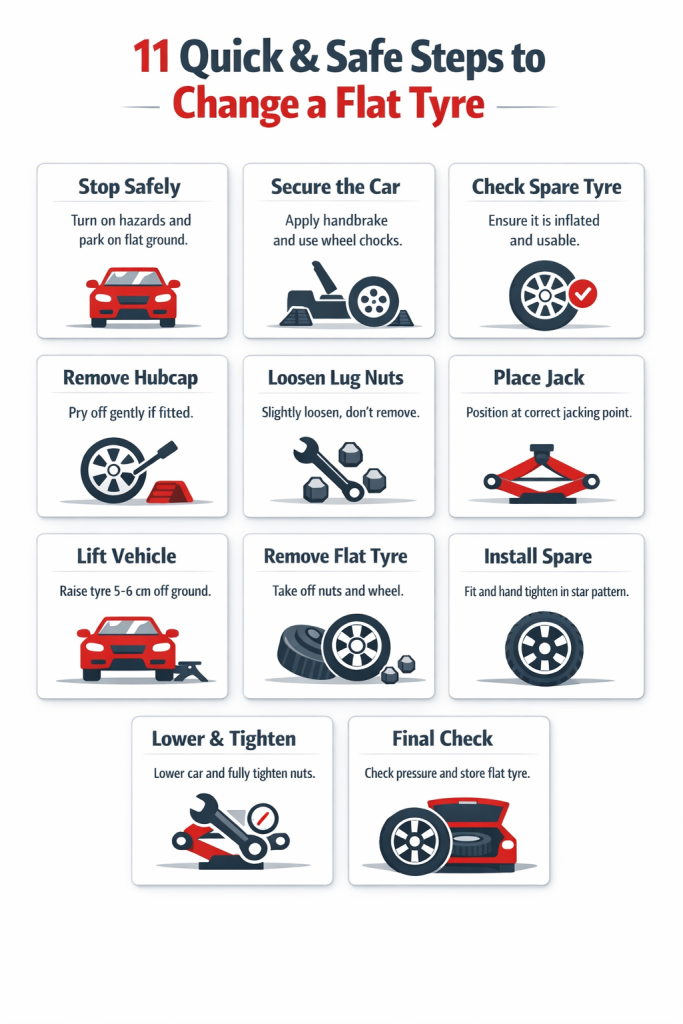
If you must change a flat tyre yourself, do it only in a safe location and follow the steps below exactly; otherwise call professional mobile tyre help.
Tools You Need for Tyre Replacement: Jack, Lug Wrench/Wheel Brace, Fully Inflated Spare (Or Space-Saver), Wheel Chock(S), Owner’s Manual, Torch, Gloves.
11 steps – do these in order
- Find a safe, flat spot & stop. Turn on hazard lights and, if needed, drive slowly off the road to a wide, stable area.
- Engage handbrake and park in gear (manual) or Park (auto). Place wheel chocks on the opposite side.
- Check the spare tyre. Confirm it’s inflated and in good condition before you start. (If unsure, call a mobile fitter.)
- Remove the hubcap (if fitted). Pry gently with the wrench’s flat end.
- Loosen lug nuts slightly (anticlockwise). Don’t remove them. Just break the seal while the wheel remains on the ground.
- Position the jack at the manufacturer’s jacking point. Consult your owner’s manual and lift only enough to clear the tyre.
- Raise the car until the flat tyre is 5–6 cm off the ground. Keep the jack perpendicular and stable.
- Remove lug nuts and the flat wheel. Place nuts somewhere safe and lift the wheel straight off.
- Fit the spare wheel, hand-thread the nuts, then tighten lightly in a star pattern. This ensures even seating.
- Lower the vehicle slowly, remove the jack, then fully tighten lug nuts to spec. If you don’t have a torque wrench, tighten firmly and re-check after 5–10 km.
- Check spare tyre pressure and stow the damaged wheel. Drive slowly to a tyre shop to repair/replace as required.
Safety notes: never get under the car when it’s on the jack; never change a tyre with your back to live traffic. Call a mobile tyre service if the location is unsafe.
How to Tell You’re Driving on a Flat Tyre: Key Signs & Alerts
If you notice sudden steering pull, louder thumping noises, heavy steering, or a dashboard tyre-pressure warning, you’re likely driving on a flat tyre. Stop safely as soon as you can.
Signs to watch for:
- Tyre Pressure Monitoring System (TPMS) light: If your TPMS flashes or a tyre pressure warning appears on the dash, pull over when safe.
- Apparent sagging or visibly flat tyre: If a tyre looks visibly lower than the others, don’t drive on it.
- Strong vibration or thumping through the steering wheel: A rhythmic thump usually means a deflated tyre or a separated tread.
- Car pulling to one side: Loss of pressure on one tyre will make the vehicle pull toward that side.
- Booming, scraping, or metallic sounds: Rim contact or debris rubbing the wheel arch indicates the tyre is dangerously low.
- Sluggish acceleration or noisy ride: Reduced acceleration or extra road noise may signal a puncture or low pressure.
- Steering feels heavy or unresponsive: Especially common where the flat is on the front axle.
- Visible bulges, cuts or cord exposure: These are emergencies so stop immediately; the tyre is unsafe even if it still holds some air.
For the most common causes behind these signs, see our deeper guide to 12 common causes of a flat tyre.
9 Pro Tips to Avoid Flat Tyres
Regular checks, timely maintenance, and avoiding common Perth hazards are the simplest ways to reduce the risk of flat tyres. Do these nine things month-by-month (or before long trips).
- Check tyre pressure monthly (when cold). Use a reliable gauge — tyre pressure varies by vehicle; follow the sticker in the driver’s door for the correct PSI.
- Inspect tyres visually each month. Look for embedded nails, cuts, bulges, or beads that indicate damage. Remove small embedded objects promptly.
- Rotate tyres every 8,000–10,000 km. Regular rotation evens wear and extends tyre life — especially important on heavily loaded 4×4s and SUVs.
- Avoid kerb and rim damage. Scrapes and curb hits weaken rims and sidewalls — common in tight Perth streets and car parks.
- Replace tyres before they hit the legal limit. Don’t wait until tread is at 1.5 mm — consider replacement at 3 mm for wet-season safety in WA.
- Carry a proper spare (or ensure run-flat tyres & TPMS are maintained). If you have run flat tyres, check their condition and the tyre pressure monitoring system regularly.
- Use sealant only as a temporary fix. Tyre sealants can help you reach a repairer but are not a long-term solution and may complicate professional repairs.
- Fit quality valve stems and dust caps; check valves during every tyre change. Faulty or corroded valves are a silent cause of slow leaks.
- Get regular wheel alignments and balances. Misalignment causes uneven wear and raises the chance of punctures — especially after Perth roadwork or rough cross-country driving.
Stuck on the side of the road? Need a fast, safe fix now?
Repair Your Flat Tyre or Get It Replaced with Premium Quality Tyres at Wangara Tyre & Auto
We specialise in fast puncture repairs, mobile tyre fitting and same-day replacements across Wangara, Landsdale, Wanneroo and nearby Perth suburbs. Whether you can fit a space-saver spare or you need us to come to you, we’ll inspect the damage, advise whether the tyre can be repaired (safely) or must be replaced, and give you a clear, honest quote before any work starts.
What you get with us:
- Quality tyres for all vehicles: passenger, SUV, 4×4 tyres, truck tyres and space-saver/full spares from quality brands.
- Mobile tyre service that comes to your location and fits while you wait.
- Professional puncture repairs and premium replacement tyres if needed.
- Wheel balancing, quick safety checks.
Don’t risk driving on a damaged tyre — call or book now and we’ll handle the rest.