How to Read Tyre Size in Australia: Complete Guide
You pull up to a tyre shop, and the bloke behind the counter asks, “What size are you after?” You freeze. You know it’s written somewhere on the tyre, a bunch of numbers and letters, but suddenly it feels like a completely different language.
But if you have looked at the tyres carefully, you will probably see some numbers like ‘205/55R16’ written on their sidewalls. This number is the correct size of the tyre, but what does it mean, and how do you decode it?
Here is why, in this article, we will explain how you can read the tyre size and choose the perfect one for your car.
What Does Tyre Size Reading Mean?
The most important question that drivers usually ask is, What do tyre numbers mean?.
The numbers and letters printed or embedded on the tyre sidewall provide important information about the tyre’s size, construction, and performance capabilities.
Why Is Reading Tyre Size Important?
Reading a tyre is essential to improve the safety, proper vehicle handling, and fuel economy of a vehicle. It helps you to pick the proper tyre dimension for your wheel rim, which can cause early wear and tear, shorter braking distances, and false speedometer readings.
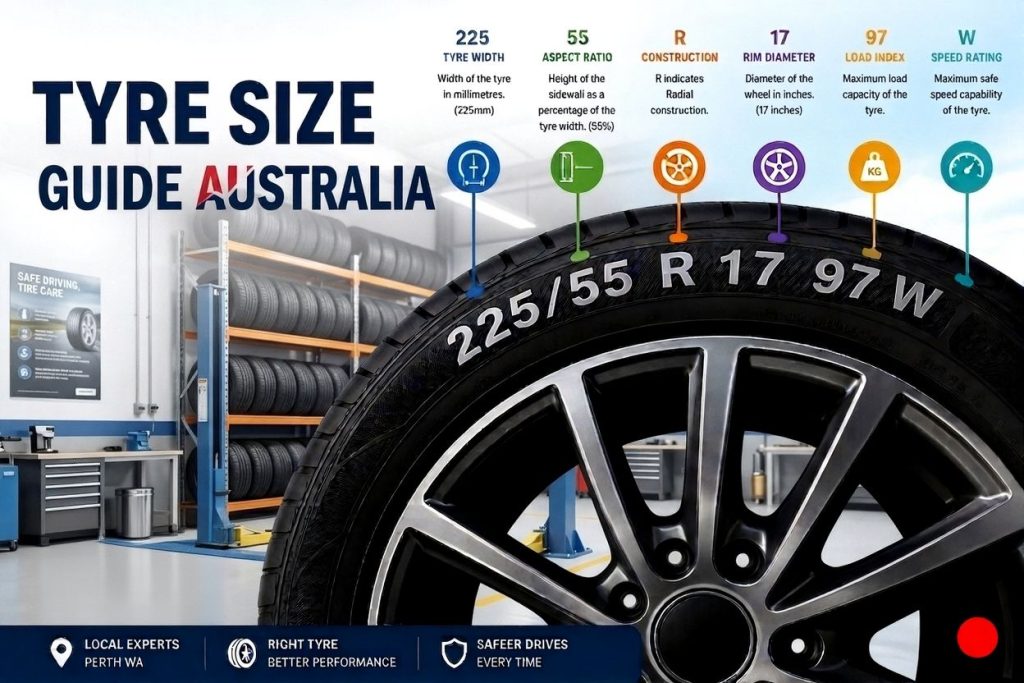
Tyre Sidewall Numbers Explained
Understanding tyre sidewall numbers helps you choose the right tyres for safety, performance, load capacity, and Australian road conditions.
A Quick View on 205/55R16 91V Meaning
| Marking | Means |
|---|---|
| 205 | Tyre width in mm |
| 55 | Sidewall height |
| R | Radial construction |
| 16 | Rim diameter in inches |
| 91 | Load index |
| V | Speed rating |
Now, let’s understand each marking in detail.
1. Tyre Width
The first 3 numbers in the tyre code are the tyre’s width. For example, in the tyre size number 205/55R16, the tyre width is 205mm.
A wider tyre provides greater road grip, better cornering, and improved handling. While they can also increase fuel use, create more road noise, and wear differently.
Besides that, for many Perth drivers, the right width depends on these factors.
- City driving condition
- Highway use
- Off-road conditions
- Towing needs
2- Tyre Aspect Ratio Explained
The next two digits represent the tyre profile or aspect ratio. This is the comparison of the tyre’s sidewall height with the tyre width.
So, in the above example, the tyre sidewall height is 55% of the tyre width, approximately 133mm.
Apart from that, a profile tyre lower than 45 improves handling, makes it feel sportier, and reduces sidewall flex. On the other hand, a profile tyre higher than 70 can provide a softer ride, lessen rough roads better, and works well for 4WD and touring
3- What Does “R” Mean?
The letter “R” in the tyre measurement code stands for “radial construction”. This standard is almost used in every modern vehicle and tyre size for 4×4 Perth, Western Australia. The reason is that it
- Stay longer
- Improve fuel expenses
- Offer a better and more comfortable ride
Moreover, another reason is that radial tyres have cord layers running at 90° in the direction the car is moving, which gives them strength, flexibility, and heat resistance. You’ll rarely see non-radial tyres on Australian roads.
4- Rim Diameter
The number after “R” is 16, and it refers to wheel diameter in inches. It should exactly match the wheel because the wrong rim size can create handling and safety issues.
Furthermore, because of a mismatch in this, the tyre will not simply seat properly.
5- Tyre Index Load in Australia
‘Tyre load index’ refers to the maximum weight a single tyre can carry when correctly inflated.
In the example above, the load index is 91, which is equal to 615 kilograms per tyre. And for a vehicle with 4 tyres, it will approximately be 2,460 kg.
This is particularly important for large vehicles like SUVs, Utes, 4WDs, towing vehicles, and work vehicles. Many Perth drivers, while upgrading tyres, must not overlook this factor, as it can affect both safety and legal compliance.
Common load index values
| Load index | Max load per tyre |
| 88 | 560 |
| 91 | 615 |
| 95 | 690 |
6- Tyre Speed Rating in Australia
The letter ‘V’ at the end of the number shows the speed rating, which means the maximum speed the tyre is designed to handle safely. Fitting a tyre with a lower speed rating than your car requires is both a safety risk and a potential legal issue.
Common ratings include
| Rating | Maximum speed |
| T | 190 km/h |
| H | 210 km/h |
| V | 240 km/h |
| W | 270 km/h |
For most Perth drivers on highways, an H or V rating is more than sufficient. While high-performance vehicles may require W or above.
How To Find Tyre Dimensions on a Car?
Here are some ways of how you can find the tyre measurement in your vehicle.
Vehicle’s Manufacturer
Your owner’s manual lists the OEM (original equipment manufacturer) tyre specifications. You can find your vehicle’s tyre dimensions in this manual.
It may also list alternative approved sizes, for example, if your vehicle is sold with different tyre options in different markets or trim levels.
Tyre Placard Australia
If tyre measurement is not mentioned in the vehicle manual, then it must be written somewhere on either the driver’s door frame, inside the fuel flap, or in the glove box area.
This placard includes information about the tyres, such as recommended tyre measurement, tyre pressure, and load specifications.
Check The Tyre Sidewall
The tyre sidewall is the easiest way to find out the tyre dimensions. Look for the numbers on its sidewalls. Also, make sure that the tyres have not been replaced previously with the wrong tyre measurement printed on them.
Tyre Dimensions For Common Vehicle Types
Tyre Size for SUVs in Perth
SUV drivers in Perth often want a balance between comfort, safety, fuel efficiency, and touring capability. Some of the popular SUVs are the Toyota Prado, Mazda CX-5, Ford Everest, and Toyota Kluger. Each comes with a different factory tyre dimension. For example:
- Mazda CX-5: typically 225/65R17 or 225/55R19
- Toyota Prado: commonly 265/65R17
- Ford Everest: often 265/60R18
- Toyota Kluger: usually 235/55R19 or 235/65R18
Tyre Size for Sedans in Perth
The tyre measurement that suits a sedan depends on the model, the grade level, and how you use the car. Common sedans and hatches on Perth roads, and the tyres they require are
- Toyota Corolla: 205/55R16
- Toyota Camry: 215/55R17
- Hyundai i30: 205/55R16 or 225/45R17 (SR grade)
- Mazda 3: 205/60R16
However, sticking close to the factory tyre dimensions keeps your speedometer accurate, maintains the correct load index, and avoids unnecessary wear on your suspension.
Tyre Size for Vans Perth
Vans use a “C” suffix in their tyre measurement, for example, 215/70R16C, where “C” stands for “commercial”. This indicates that such tyres are built to handle higher loads than a standard passenger tyre.
Popular vans in WA and their common factory sizes
- Toyota HiAce: 215/70R16C
- Ford Transit Custom: 215/65R16C or 215/60R17C
- Ford Transit (full size): 235/65R16C
Tyre Size for Trucks Perth
Trucks require a different approach to tyre dimensions altogether. For example, light trucks and medium commercial vehicles in Perth run on heavy-duty tyres with high load and speed ratings to match their work.
Common sizes for popular light and medium truck tyres in Australia
- Isuzu NPR (light truck): 195/85R16C or 215/85R16C
- Hino 300 Series: 195/75R16C
- Hino 500 / larger medium trucks: 295/75R22.5 or 315/70R22.5
Common Tyre Measurement Mistakes to Avoid
Here are some common mistakes people make while choosing the tyre dimension.
- Choosing the wrong load rating.
- Ignoring the speed rating.
- Selecting the oversized tyres.
- Filling with incorrect tyre pressure.
- Fitting different sizes on the same axle
Conclusion
Finding the right tyre size for the vehicle is not confusing; you just need to know a few basic key elements to read this. And by learning how to read tyre sidewall markings, load ratings, and speed ratings, choosing the right tyres becomes much easier.
Whatever the vehicle you drive, whether it is a family SUV, work ute, or touring 4WD, the correct tyre dimensions improve safety, comfort, fuel economy, and handling. It also helps keep your vehicle compliant with Australian road rules.
Feeling Like Your Car Needs Tyre Replacement?
Get The Correct Size Tyre from Wangara Tyre and Auto
At Wangara, we help Perth drivers choose the right tyres for daily driving, towing, off-road touring, and performance vehicles. Our team focuses on honest advice, quality workmanship, and practical tyre solutions suited to WA conditions.
What We Offer Our Customers
- Tyre fitting and replacement
- Wheel alignments and balancing
- 4WD and SUV tyre upgrades
- Vehicle servicing and maintenance
- Expert tyre advice for Perth conditions
FAQ
Can I fit 235 tyres instead of 225?
Yes, if you want a steadier ride and improved traction and want to upgrade their tyres from 225 to 235, they can fit 235 tyres instead of 225.
What does ‘205 55 R16 91V’ mean?
The numbers and letters in this tyre dimension mean:
- 205: Tire width in mm
- 55: sidewall height
- R: radial construction
- 16: Rim diameter in inches
- 91: Load index
- V: Speed rating
What is the 3% tyre rule?
This rule says that the overall diameter of the new tyre must not differ from the previous tyre by more than 3%.
How do I identify my tyre size?
You can identify a tyre measurement by these 3 ways:
- By looking in the vehicle manual.
- On the sidewall of the tyre.
- Driver’s door frame
- On the fuel flap
- In the glove box area
What does ’91V’ on a tyre mean?
In code 91V, the ’91’ tyre marking means that the tyre can hold a load of 615 kg per tyre, and ‘V’ shows that it has a maximum speed capability of 240 km/h.
One Response