
You’ve checked for nails, run soapy water over every inch of tread, and found nothing, yet the same tyre is still down a few PSI by morning. Frustrating, isn’t it?
The real cause of a tyre losing pressure without a puncture is usually a leaking valve stem, a bead leak where the tyre meets the rim, a corroded or bent wheel, temperature swings, an old repair breaking down, natural rubber ageing, or a puncture too fine for a spray bottle to catch. If one tyre keeps dropping more than 2-3 PSI over a few days while the others hold steady, that’s an active leak, not a coincidence, and it needs a proper inspection rather than another top-up.
Below, we’ll go through exactly what’s causing the tyre pressure loss, how to identify the problem from your symptoms, and the most effective solutions to get your tyre holding pressure again.
Why Do Tyres Lose Pressure Without a Puncture? 9 Common Causes & Solutions
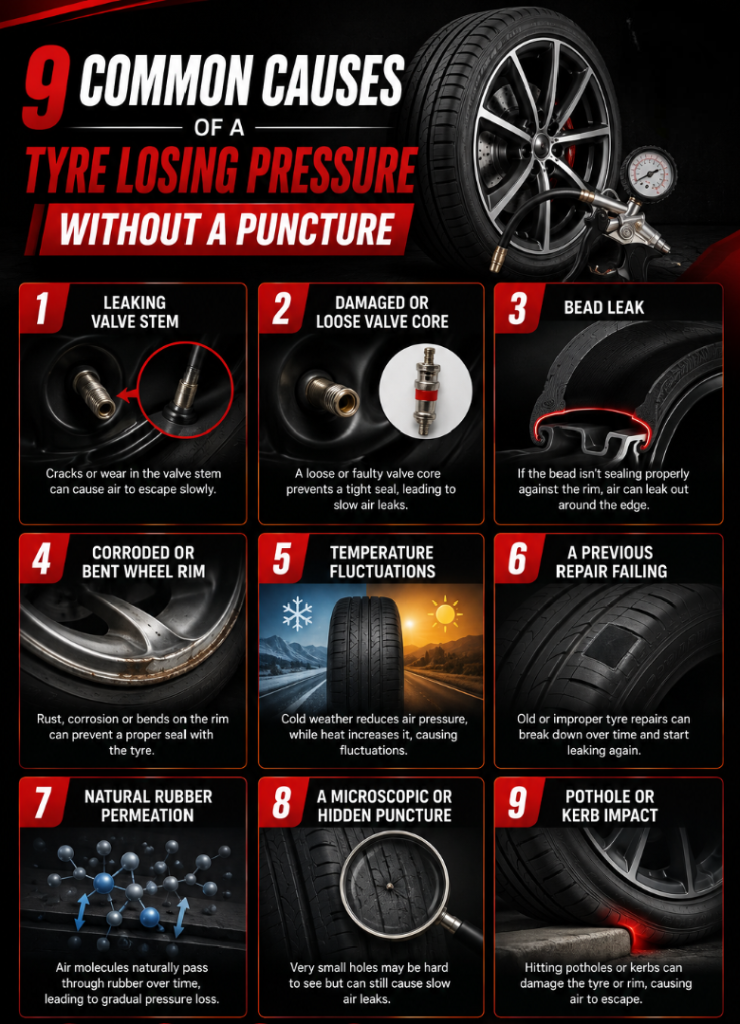
If you’re dealing with a tyre losing air but no visible puncture, the cause is almost always one of the following nine issues rather than a hidden nail. Each one has a distinct mechanism and a specific fix.
1. Leaking Valve Stem
Rubber valve stems are made from a synthetic rubber compound that oxidises with heat and UV exposure over several years. As the rubber oxidises, it loses elasticity and develops fine cracks right at the base, exactly where the stem meets the wheel. That’s the point air escapes from, usually slowly enough that it only costs a few PSI a week.
Solution:
The stem needs replacing, not just topping up around it. It’s a low-cost part and a quick job once the tyre is off the rim, which is why most reputable tyre shops replace the valve stem as standard practice whenever a tyre is refitted.
2. Damaged or Loose Valve Core
The valve core is the small, spring-loaded pin inside the stem that seals the tyre shut. It can lose its seal for a few reasons such as general wear on the seat, being over- or under-tightened during a previous fit, or fine dirt and grit lodging under the pin and holding it open by a fraction.
Solution:
A valve core tool re-seats and tightens it correctly in seconds. If the core is worn rather than just loose, it gets swapped for a new one. This is one of the cheapest checks available and should always be ruled out before assuming a bigger repair is needed.
3. Bead Leak
The bead is the inner edge of the tyre that seals directly against the wheel rim. Corrosion on alloy rims forms a fine white oxide layer that prevents a truly airtight metal-to-rubber contact, and a poorly lubricated or rushed fitting can leave the bead not quite fully seated. Either way, air escapes gradually around the rim’s edge rather than through the tyre itself, which is why this cause is so often missed on a standard visual check.
Solution:
The tyre is demounted, the bead seat is wire-brushed back to bare metal, a bead sealant is applied, and the tyre is reseated with the correct lubricant. Done properly, this resolves the leak in well under an hour.
4. Corroded or Bent Wheel Rim
Alloy rims corrode over time from moisture and road grime, and even a small bend from a pothole or kerb strike is enough to break the seal between tyre and wheel. This is a particularly common cause of a tyre losing air without puncture damage on Perth roads, since potholes are more common after winter rain and many outer-suburb and semi-rural routes still have rough or unsealed sections.
Solution:
Minor corrosion can be cleaned and resealed. A rim with a light bend can often be professionally straightened and rebalanced. If the rim is cracked or badly pitted, replacement is the safer option, since a compromised rim can fail without warning under load.
5. Temperature Fluctuations
Tyre pressure follows basic gas behaviour: as air inside the tyre cools, it contracts and pressure drops, and as it warms, pressure rises again. As a rule of thumb, pressure changes by around 1 PSI for every 5–6-degree shift in temperature. A cool Perth morning after a hot afternoon is enough on its own to trigger a TPMS warning with no leak involved at all.
Solution:
This isn’t a fault to repair. Reset pressure to the door placard spec on a cool morning, then monitor for a few days. If the pressure keeps dropping beyond what temperature alone explains, treat it as a genuine leak and have it inspected.
6. A Previous Repair Failing
A plug-only repair seals the outer tread but doesn’t bond to the tyre’s inner liner, so it can work loose or develop a slow seep as the surrounding rubber ages and flexes with driving. Even a correctly installed patch-plug can fail years later if the original puncture wasn’t properly buffed and prepared before the repair was applied.
Solution:
Have the repair redone properly with an internal patch-plug combination rather than a plug alone, particularly if the original fix was an external plug-only repair. This is the industry-recommended method and bonds directly to the inner liner for a lasting seal.
7. Natural Rubber Permeation
All tyre rubber is slightly porous at a molecular level, so air molecules gradually pass through the tyre wall itself even with zero damage anywhere. Older tyres typically lose around 1 to 3 PSI a month this way, and the rate increases slightly as the rubber ages and hardens.
Solution:
No repair is needed here. Check pressure monthly and top up as required. If you’re topping up often on tyres over three or four years old, switching to nitrogen inflation can slow the permeation rate, since nitrogen molecules are larger and pass through rubber more slowly than the oxygen in regular air.
8. A Microscopic or Hidden Puncture
Fine wire, a small stone chip, or a shard sitting flush in the tread can sit tight enough to seal most of the time, only leaking when the tyre flexes under load while driving. A quick spray-bottle test at home often misses these, since the hole only opens under pressure and movement, not while the wheel is sitting still.
Solution:
A full immersion test in a water tank at a tyre shop catches what a spray bottle can’t, since consistent underwater pressure reveals even the smallest bubble stream. If the puncture sits within the repairable tread zone, an internal plug-patch resolves it in one visit.
9. Pothole or Kerb Impact
A hard hit can bend the rim or knock the bead loose without leaving any mark you’d notice on the tyre itself, which is exactly why so many drivers rule out impact damage after a pothole. This is a frequent cause after road damage in Perth’s outer suburbs, and it comes up regularly with 4WDs after gravel-track trips out to Lancelin.
Solution:
Get the wheel and tyre inspected after any hard hit, even if there’s no immediate leak, since bead and rim damage from an impact often doesn’t show up as a pressure drop until days later.
Real Examples of Tyres Losing Air Without a Visible Puncture
These situations come up often, and each one has a clear, identifiable cause once you know what to look for.
Example #1:
“I filled my tyre to 36 PSI yesterday. This morning it was down to 29 PSI, and the tyre shop couldn’t find a puncture. It’s happened three times this month, always the same front tyre.”
Cause: With no puncture found under a soapy water test and a drop this fast overnight, the fault sits with the valve or the bead seal, not the tyre itself. A repeated pattern on the same wheel points to a valve core that needs replacing, or a bead that isn’t fully seated against the rim. Get it checked before it strands you at a dangerously low pressure.
Example #2:
“After hitting a pothole, my tyre pressure keeps losing without puncture, around 3 PSI every few days. I’ve topped it up four times since.”
Cause: A pothole hard enough to bend a rim, even slightly, will affect the seal before it ever affects the tyre. A steady, repeatable loss like this, rather than a sudden flat, confirms a bent rim or a bead knocked loose by the impact, not a missed puncture. The wheel needs to come off and be checked properly. Topping it up in the meantime only buys time; it doesn’t fix anything.
Example #3:
“Every winter my TPMS light comes on, then disappears once I’ve been driving for a while.”
Cause: This is temperature, not a leak. Cold, denser air reads lower first thing in the morning and climbs back up once the tyre warms from driving. No repair is needed, provided the pressure returns to normal and doesn’t keep dropping once the tyre has fully warmed through.
How to Diagnose a Deflated Tyre Leak at Home
If your tyre is losing air but has no puncture, this table and checklist will help narrow down the cause before you book an inspection.
| Symptom | Most Likely Cause |
| One tyre loses 5+ PSI overnight. | Valve or bead leak |
| Pressure drops after hitting a pothole. | Bent rim |
| TPMS light only on cold mornings | Temperature change |
| Pressure drops only while parked. | Valve or bead leak |
| Pressure drops after a repair. | Failed patch or plug |
| Same tyre loses air every week. | Micro puncture |
Before booking a tyre repair, check:
- Valve cap is on and undamaged
- Valve stem for cracks or wear
- Tread for embedded screws or debris
- Sidewall for cuts, bulges or wear
- Wheel rim for corrosion or bends
- Whether the TPMS warning is on one tyre or all four
- Pressure on all four tyres, not just the one you suspect
Is It Normal for a Tyre to Lose Pressure Over Time?
Losing a small amount of air each month is completely normal, and it’s expected that tyres lose air without a puncture over their lifespan simply from ageing rubber. Losing air quickly or repeatedly is not normal and should be checked.
Normal:
- Around 1 to 3 PSI lost per month
- A dip in pressure after a cold snap or overnight temperature change
- Slight pressure loss after the car has sat unused for a few weeks
Not normal:
- Losing 5 or more PSI overnight
- One tyre consistently lower than the other three
- Needing to add air every few days
- Repeated TPMS warnings on the same wheel
When Should You Stop Driving on a Low-Pressure Tyre? Signs to Get Your Tyre Checked
How long can you drive with loss of tyre pressure? A tyre that’s only slightly under pressure is fine for normal driving until it can be checked. A tyre losing air quickly shouldn’t be driven more than a short distance at low speed, since running underinflated builds heat inside the tyre and raises the risk of a sudden blowout.
So, stop driving and get the tyre checked immediately if you notice any of the following signs:
- The tyre has lost more than 8 PSI overnight
- Visible sidewall damage or a bulge
- Exposed cord or fabric through the rubber
- A clearly bent or cracked rim
- Pressure sitting below the level shown on the door placard
Outside of these situations, book a professional inspection as soon as one tyre is consistently lower than the rest.
Can a Tyre Losing Pressure Without Puncture Be Repaired or Replaced?
Most valve, bead and small tread issues can be repaired. Sidewall damage, badly corroded beads or tyres with old, hardened rubber usually need replacing rather than repairing. A valve replacement or bead reseal is a quick, low-cost fix. If the tyre itself is compromised, patching it is a false economy.
Buy new tyres because the tyre losing pressure without puncture symptoms will likely return within weeks.
How to Stop Your Tyre Losing Pressure Again
A few simple habits go a long way toward stopping a tyre losing air without puncture damage from becoming a recurring problem:
- Check pressure monthly, ideally when tyres are cold
- Replace valve cores every time new tyres are fitted
- Have wheels inspected for corrosion at each service
- Get any pothole or kerb strike checked, especially before a longer trip out to Lancelin or Mandurah
- Keep all four tyres at the door placard spec, not just “close enough”
FAQs
Is it safe to drive on a tyre that keeps losing air?
Short distances at low speed are usually fine if the drop is minor. But repeated or rapid pressure loss should be checked before you drive any further, especially on the freeway.
Is it normal for a tyre to lose 2 PSI overnight?
No. Losing 2 PSI overnight is well above the normal range of roughly 1 to 3 PSI a month. So, it points to an active leak, most likely the valve or bead, rather than routine seasonal loss. It’s worth getting checked before it gets worse.
How often is it normal to put air in your tyres?
Checking monthly and topping up occasionally, especially with seasonal temperature changes, is normal. Needing to add air to the same tyre every week or two isn’t, and points to a leak that needs finding rather than repeat topping up.
How much PSI loss is normal per month?
Around 1 to 3 PSI per month is considered normal for most passenger tyres.
Can a tyre lose air from the rim rather than the tyre itself?
Yes. A bead leak or a corroded rim is a common way tyres lose air without a puncture in the rubber at all.
Why does my TPMS light only come on in the morning?
This is usually temperature-related. Cold mornings lower pressure enough to trigger the sensor. The warning often clears once the tyre warms up from driving.
How much does it cost to fix a slow tyre leak in Perth?
Fixing a slow tyre leak in Perth typically costs between $35 and $50+ at a physical tyre shop. Valve replacements and bead reseals are generally inexpensive, while a full tyre replacement costs more. Ask for a free diagnosis before assuming a new tyre is needed.
Stop Guessing. Get Your Tyre Properly Checked at Wangara Tyre & Auto
If your tyre keeps losing pressure and no puncture can be found, don’t keep topping it up and hoping it holds. Our team checks the valve, wheel rim, bead and internal tyre condition to find the real cause, not just guess at it.
We specialise in tyre servicing and repairs, including puncture repairs, wheel alignments, tyre fitting and balancing, and brake checks, so your vehicle stays safe on Perth roads.