Second-hand tyres can save you real money, or cost you a defect notice, a blowout, or a repair bill on your differential, depending on one thing: whether you know what to check before you buy.
A used tyre with even tread, a recent manufacture date, and no internal damage can safely see out its life. A used tyre with hidden belt separation can fail at highway speed. Here’s exactly what separates the two.
7 Things To Consider Before Buying Second-Hand Tyres
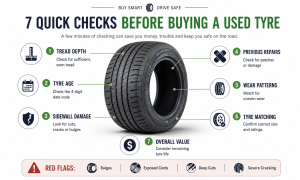
Run through these seven checks on any used tyre before you hand over cash, whether you’re buying from a tyre shop, a wrecker, or a private seller.
1. Tread depth
Start here, because it’s the fastest way to rule out an unsafe tyre. In Western Australia, tyres must have a minimum tread depth of 1.5mm across the required tread area. However, for better wet-weather grip and braking performance, consider replacing tyres before they reach the legal minimum. Once a tyre drops below 3mm, braking distances in the wet increase noticeably, so treat 3-4mm as your realistic buying threshold.
Two easy ways to check:
- Tread Wear Indicators (TWI): small raised bars moulded into the base of the tread grooves. Once the tread wears level with these bars, the tyre is at the legal limit.
- The 20-cent coin test: insert an Australian 20-cent coin into the groove with the platypus’s bill pointing down. Tread covering the bill → safe. Whole bill visible → nearing the end of its life.
A digital tread depth gauge ($10-15 from any auto parts store) gives a precise reading. Check multiple points around the circumference, not just one spot, since uneven wear can hide a low reading elsewhere.
2. Tyre age (the DOT code)
A tyre’s age matters just as much as its tread, sometimes more. Every tyre sold in Australia carries a DOT code on the sidewall, ending in a 4-digit number. The first two digits are the week of manufacture, the last two are the year. A code reading “2422” means the tyre was made in the 24th week of 2022.
Rubber oxidises and hardens over time, even on a tyre that’s barely been driven. This matters more in Australia, where harsh UV exposure and high road temperatures accelerate degradation faster than in cooler climates.
- Under 3 years old → generally fine if tread and structure check out
- 3-5 years old → inspect the sidewalls carefully
- Over 5-6 years old → avoid, regardless of remaining tread
Don’t take the seller’s word for it. Find the DOT stamp yourself before agreeing to buy.
3. Sidewall and weather damage
Run your hand around the entire sidewall, inside and out, feeling for anything that shouldn’t be there. Sidewall damage is often more dangerous than tread wear because it sits closer to the tyre’s structural belts.
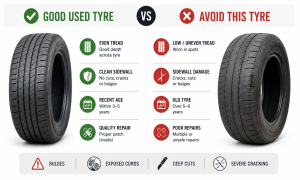
- Bulges → the internal casing has separated from the outer rubber. Automatic reject, no matter how good the tread looks.
- Dry rot cracking → fine, spider-web cracks caused by prolonged UV and heat exposure. Light surface cracking can be cosmetic; deep or widespread cracking means the rubber compound has broken down.
- Cuts and gouges → anything deep enough to expose the internal cords is a reject.
- Chemical staining → can indicate poor storage or exposure to fuel or oil, which degrades rubber from the outside in.
4. Puncture repairs
Not all puncture repairs are equal, and some are illegal to sell. Flip the tyre and check the inner liner.
- Mushroom plug-patches, applied from the inside, are the only repair method considered safe and roadworthy.
- String plugs (pushed in from the outside with no internal patch) are a temporary fix at best and unsafe for ongoing use.
- Multiple patches on one tyre are an automatic reject, since the structure and air-holding ability are already compromised.
- Repairs on the shoulder or sidewall are never acceptable under Australian repair standards. Walk away from these entirely.
5. Wear pattern and history
Uneven wear tells you what happened to the tyre before you saw it, and whether the same fault could come back. Run your hand across the tread from inside edge to outside edge.
Wear pattern | What it looks like | What it usually means |
Centre wear | Worn more in the middle than the edges | Tyre was overinflated |
Shoulder wear (both sides) | Both outer edges worn more than the centre | Tyre was underinflated |
One-sided shoulder wear | Wear on just one edge | Wheel alignment or camber issue |
Feathering | Tread blocks smooth one way, sharp the other | Toe misalignment, often with steering pull |
Scalloping/cupping | Evenly spaced dips around the tyre | Worn suspension or an unbalanced wheel |
Heavy feathering or scalloping isn’t automatically unsafe, but it flags a mechanical issue on the previous vehicle that could reappear on yours if it was never fixed.
6. Size, speed rating, and axle matching
Buying the cheapest tyre that “fits” your rim size can cost more than you save if it doesn’t match the tyres already on your car. Size, tread pattern, and remaining tread depth all need to stay close across an axle, ideally across all four wheels.
This matters most on AWD and 4WD vehicles. These systems constantly measure how fast each wheel spins, and even a small diameter difference, caused by mismatched brands or uneven wear, forces the centre differential and transfer case to work harder than designed. Left unchecked, this leads to premature drivetrain wear that costs far more than any saving on the tyre itself.
Not sure what size or speed rating your vehicle needs before you start shopping? Our guide on how to read your tyre size in Australia covers exactly what to look for on the sidewall.
7. The real cost and the seller’s reputation
A cheap tyre with a short remaining life, or one that fails a roadside inspection, isn’t actually cheap. Used tyres typically cost 40-60% less than new ones, which is why they stay popular, but the maths only works if the tyre has genuinely been checked first.
- Shorter remaining life → a tyre with 4mm left needs replacing sooner, so the cost per kilometre can end up similar to buying new.
- Defect notices → driving on a tyre below 1.6mm tread in WA and most other states can mean a defect notice, a fine of over $100 per tyre, and demerit points.
- No warranty → most private sellers won’t guarantee anything, so a tyre that fails within a week is your problem alone.
Buy from a seller who inspects and grades their used stock, not from an unchecked private sale, and the savings actually hold up.
The Hidden Defect Risk Most Buyers Never See
The biggest risk with second-hand tyres isn’t what you can see; it’s what’s happening inside the tyre. A large-scale investigation of part-worn tyres in the UK found that more than a third of tyres pulled from general sale had faults serious enough that they should never have been sold, ranging from unrepaired punctures to internal cord damage invisible from the outside. Australia has no equivalent mandatory testing regime for used tyres, so catching these faults falls almost entirely on the seller’s inspection process, or on you.
Internal belt separation is the most dangerous hidden fault. It happens when the steel belts inside the tyre lose their bond with the rubber, often after an impact, a pothole strike, or a period of underinflation the previous owner never noticed.
A tyre with belt separation can look completely normal from the outside and still fail catastrophically at speed. This is exactly why a visual check alone was never designed to be the final word, and why every check in this guide matters together, not on its own.
Buy Second-Hand Tyres That Have Already Passed This Checklist
At Wangara Tyre & Auto, we run this exact inspection process on every used tyre before it goes back on our shelves, so you’re not left guessing at tread, age, or hidden damage when you buy.
We carry a large range of quality second-hand tyres for sedans, SUVs, and 4x4s at our workshop in Landsdale, alongside new tyres from trusted brands and free expert advice on matching the right set to your vehicle.
Don’t risk a defect notice or a blowout on an unchecked tyre. Talk to our team, and we’ll help you find a safety-tested used tyre that actually fits your budget and your car.
FAQs
Is it legal to buy and sell second-hand tyres in Australia?
Yes. There’s no law banning the sale of used tyres, and no mandatory “part-worn” labelling like the UK. This means the buyer, not the seller, carries most of the responsibility for checking safety.
How long do second-hand tyres actually last?
A used tyre with 3-4mm of tread typically lasts another 15,000-25,000km, depending on driving style, climate, and how evenly it wears. Tyres with deeper tread or gentler use can last longer.
Is it safe to buy second-hand tyres from Facebook Marketplace or Gumtree?
It’s riskier than buying from a shop, since there’s no professional inspection. If you go this route, check tread, DOT age, and sidewalls yourself, or have a tyre specialist inspect it before fitting.
Can you mix new and second-hand tyres on the same axle?
Avoid it where possible. Different tread depths change the tyre’s rolling diameter, which can throw off braking balance and, on AWD or 4WD vehicles, strain the differential over time.
How much do second-hand tyres cost in Australia?
Second-hand tyres on average cost $40-$90 each, roughly 40-60% less than a comparable new tyre, depending on brand, size, and remaining tread depth.