Tyre Speed Rating System in Australia: What Does It Mean?
There’s a letter stamped on every tyre you’ve ever bought, and most drivers never look at it. That letter is your tyre’s speed rating, and it tells you far more than just how fast you can drive. It affects your braking performance, cornering response, heat resistance, and even whether your insurance will pay out if something goes wrong.
A tyre speed rating is a letter code that indicates the maximum sustained speed a tyre can safely handle under load in controlled test conditions.
Every new tyre sold in Australia must meet minimum speed rating requirements under Australian Vehicle Standards. Choose the wrong one, and you’re not just taking a performance hit; you could be driving illegally.
Here’s everything Perth drivers need to know.
What Is a Tyre Speed Rating?
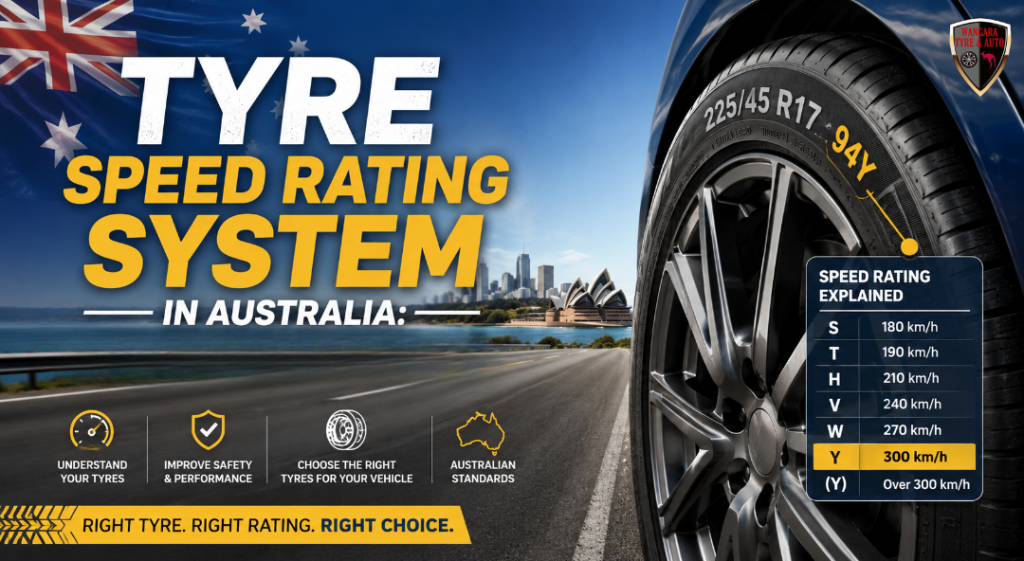
The tyre speed rating is the maximum speed a tyre can safely carry its rated load for a sustained period under ideal conditions. It reflects the tyre’s ability to manage heat buildup, because at high speeds, heat is the primary cause of tyre failure. Common ratings include H (210 km/h), V (240 km/h), and W (270 km/h).
Speed rating is represented by a single letter, which you’ll find at the end of the tyre’s size code on the sidewall. For example, in the code 205/55R16 91V:
- 205 = tyre width in millimetres
- 55 = aspect ratio (sidewall height as % of width)
- R16 = radial construction, 16-inch rim
- 91 = load index (615 kg per tyre)
- V = speed rating (maximum 240 km/h)
How to Read Tyre Markings and Find Your Speed Rating
You can find your vehicle’s required speed rating in three places:
- The tyre sidewall: look for the letter at the end of the size code
- The vehicle placard: usually in the glove box or on the inside of the driver’s door jamb
- Your owner’s manual: lists all recommended tyre specifications
Tyre Speed Rating Chart – Australia
The following table shows the standard speed rating letters, their maximum speed in km/h, and the vehicle types they’re commonly used on:
Rating | Max Speed (km/h) | Common Application |
N | Up to 140 km/h | 4WD/off-road tyres |
Q | Up to 160 km/h | Studded/studless winter tyres |
S | Up to 180 km/h | Passenger cars (family sedans) |
T | Up to 190 km/h | Passenger/light truck |
H | Up to 210 km/h | Sedans, sports cars, SUVs |
V | Up to 240 km/h | Performance cars, large SUVs |
W | Up to 270 km/h | High-performance vehicles |
Y | Up to 300 km/h | Sports/supercar |
Tyre Speed Rating Laws in Australia: What’s Legal?
Australia has clear minimum tyre speed rating requirements under its Vehicle Standards rules. These apply regardless of state or territory:
- Passenger vehicles: minimum S rating (180 km/h)
- 4WDs with off-road features: minimum N rating (140 km/h)
The speed rating must be stamped on the tyre; it cannot simply be claimed
Fitting tyres with a lower speed rating than required is illegal in Australia and can void your insurance. Even if you never intend to drive fast, your insurer may refuse to cover an accident if non-compliant tyres are found on your vehicle.
Can You Fit a Higher Speed Rating Than Recommended?
Yes, and there are real benefits. Upgrading to a higher speed rating typically improves cornering response, braking performance, and heat resistance. A V-rated tyre on a car that only requires H will perform consistently at highway speeds with extra thermal headroom.
However, there are important rules when mixing ratings:
- Never fit a tyre with a lower rating than your manufacturer’s specification
- If mixing ratings, put the lower-rated tyres on the front axle. This helps prevent oversteer (rear-end loss of traction)
- The overall speed limit for your vehicle becomes that of the lowest-rated tyre fitted
- Most tyre manufacturers recommend replacing in full sets of four; if replacing in pairs, match ratings on the same axle
Tyre Speed Ratings for 4x4s and SUVs in Perth
Perth drivers face some of the most demanding tyre conditions in Australia. Long open highways like the Great Eastern Highway, high summer temperatures that accelerate heat buildup in tyres, and vehicles regularly switching between highway driving and off-road weekends – all of this puts extra pressure on tyre performance ratings.
For 4WD drivers in Perth and the surrounding Wangara, Wanneroo and Pearsall areas, it’s important to understand:
- The legal minimum for off-road 4WDs is N (140 km/h). This is a floor, not a target
- All-terrain (A/T) tyres fitted for WA’s outback tracks should still meet your vehicle’s placard speed rating
- Loaded touring setups (rooftop tents, drawers, and water tanks) put additional stress on tyres. Check both speed AND load ratings together
- H and T-rated all-terrain tyres are common choices for Perth dual-use 4WDs
What Happens If You Ignore Your Tyre Speed Rating?
Speed ratings aren’t suggestions; they exist because tyres behave differently under thermal and mechanical stress at speed. Fitting the wrong tyre puts you, your passengers, and other road users at risk.
- Heat-induced blowout risk: under-rated tyres build heat faster than they can dissipate it, leading to sudden failure
- Reduced steering and braking response at highway speeds
- Insurance may be voided if non-compliant tyres are found after an accident
- Fitting tyres with a lower rating than the placard is illegal under Australian vehicle standards.
One important safety note: if a tyre has been punctured or repaired, it no longer retains its original speed rating. A repaired tyre should be treated as downgraded for performance purposes.
Quick Tyre Safety Checklist for Perth Drivers
Before you buy new tyres or after any rotation or repair, run through this checklist:
- Speed rating matches or exceeds the vehicle placard specification
- Load index meets or exceeds manufacturer requirements
- The tyre sidewall is free from cracks, bulges, or damage
- No mixing of lower and higher ratings on the same axle without front placement of the lower-rated pair
- Repaired or punctured tyres are treated as non-speed-rated
- Tyre pressure is correct for the load you’re carrying
Unsure whether your current tyres meet your vehicle’s speed rating requirements?
Drop into Wangara tyre shop in Landsdale. We’ll check your tyre markings, placard specs, and overall tyre condition for free. Serving Wangara, Wanneroo, Pearsall and all of Perth’s northern suburbs.
Find the Right Premium Tyres for Your Vehicle at Wangara Tyre & Auto
We stock a full range of passenger, SUV, 4×4 tyres, and truck tyres from brands including Kumho, Dunlop, Sailun, and more, all with the correct speed ratings for Australian conditions.
FAQs About Tyre Speed Ratings
What is the most common tyre speed rating in Australia?
The H rating (210 km/h) is one of the most widely fitted speed ratings on Australian passenger vehicles, including sedans and family SUVs. T (190 km/h) is also common on smaller passenger cars. For 4WDs, S, T, and H-rated all-terrain tyres are the most frequently fitted.
What does an H rating mean on a tyre?
H rating refers to the tyre’s ability to withstand speeds of up to 210 km/h under load. This means the tyre performs well in terms of handling capabilities and heat resistance.
What tyre should I buy?
Buy tyres that match or exceed your vehicle manufacturer’s recommended size, load index, and speed rating. This will result in better safety and control as well as legal requirements.
Can I replace my tyres with a higher speed rating?
Yes. Fitting a higher speed rating than your vehicle’s placard specifies is permitted and may improve handling and braking. You should never fit a tyre with a lower rating than the placard requires, as this is illegal in Australia and voids insurance.
What happens if I fit tyres with different speed ratings?
All tyres should ideally have the same speed rating; otherwise, the ability to travel at fast speeds will be restricted to the lowest rated speed of all the tyres.
Can you drive faster than your tyre speed rating?
No. A tyre’s speed rating is the maximum speed it can safely sustain under load. Exceeding that rating increases heat build-up and the risk of tyre failure.
Does tyre speed rating affect insurance?
Yes, fitting tyres which fall below the vehicle manufacturer’s minimum recommendations will influence insurance, as well as pose potential problems during a vehicular accident if the vehicle does not meet the required specifications.
What speed rating do I need for a 4WD in Australia?
As per the Australian Vehicle Standards, a 4WD with off-road capabilities needs a tyre which at the very least is capable of N speed (140 km/h). However, those who drive their vehicles on WA’s highways need to use tyres with S, T, or H speed ratings.