The numbers stamped on a tyre’s sidewall aren’t decoration. These are truck tyre size and load ratings. They tell you the size, the construction, how much weight the tyre can carry, and how fast it’s rated to run.
In this guide, we are going to tell you how you can read truck tyre sizes and how truck tyre load ratings actually work. So let’s begin.
How to Read Truck Tyre Sizes
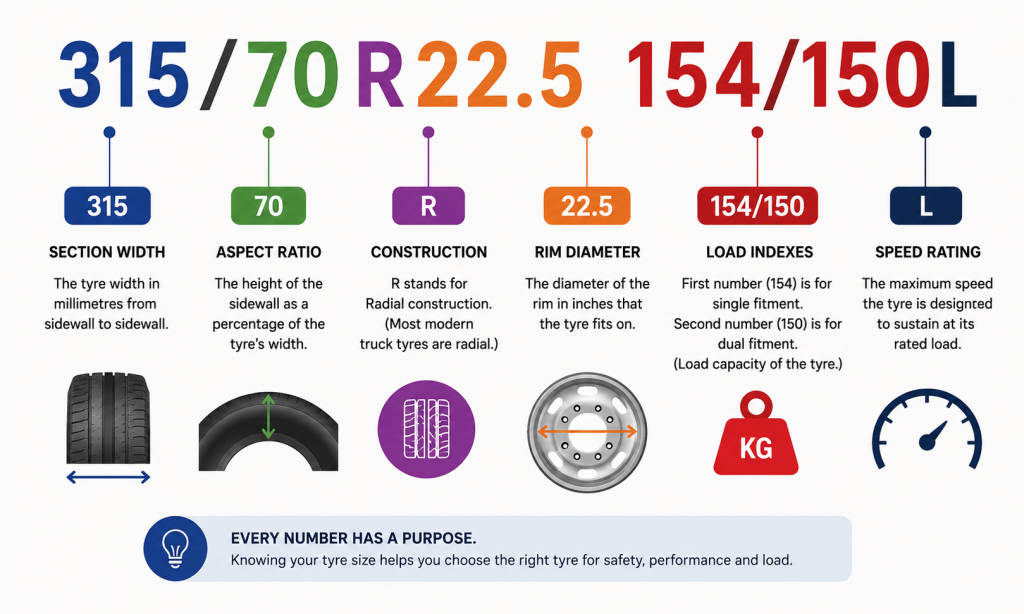
Let’s say you’re standing beside your truck and notice this marking on the tyre sidewall:
315/70R22.5 154/150L
At first, it looks like a random string of numbers and letters. But each part is actually telling you something useful about that tyre. Let’s break it down together:
- 315 – This is the tyre’s section width, measured in millimetres from one sidewall to the other.
- 70 – This is the aspect ratio. It means the sidewall height is 70% of the tyre’s width.
- R – This tells you the tyre uses radial construction, which is standard on most modern truck tyres.
- 22.5 – This is the rim diameter, measured in inches.
- 154/150 – These are the load indexes. You’ll see two numbers because the tyre has different rated capacities for single and dual fitment. We’ll get into that shortly.
- L – This is the speed symbol, showing the maximum speed the tyre is designed to sustain at its rated load under specified conditions.
So, if you’re looking at your own truck and see something like 315/70R22.5, you don’t need to guess what those numbers mean or simply order the same tyre because “that’s what’s already on there.”
Once you know how to read the marking, you can understand exactly what you’re looking at and, more importantly, start checking whether it’s actually the right tyre for your truck.
If you want the full breakdown of what each speed letter means, our tyre speed rating guide for Australia covers it in more detail.
Metric vs Traditional Truck Tyre Sizes
Truck tyres are sold in two different sizing formats, and both are common in Australian fleets, including plenty we see come through our Perth workshop. Metric sizes look like 295/80R22.5, 315/70R22.5, 315/80R22.5 or 385/65R22.5. Traditional sizing looks like 11R22.5, with the tyre width expressed in inches rather than millimetres and without an aspect-ratio number.
Neither format is “better.” Which one you need comes down to what your vehicle manufacturer specifies, not personal preference. Some truck and trailer combinations are built around metric sizing; others still run traditional. If you’re unsure which category your current tyres fall into, our guide on how to read tyre sizes in Australia breaks down the format differences in more detail.
Common Truck Tyre Sizes and What They Mean
Examples of truck tyre sizes include:
Truck Tyre Size | What It Tells You |
11R22.5 | Traditional 22.5-inch truck tyre sizing |
295/80R22.5 | 295mm width, 80 aspect ratio, 22.5-inch rim |
315/70R22.5 | 315mm width, 70 aspect ratio, 22.5-inch rim |
315/80R22.5 | 315mm width, 80 aspect ratio, 22.5-inch rim |
385/65R22.5 | Wide 385mm tyre on a 22.5-inch rim, often seen on trailer axles |
A word of caution here: these sizes aren’t interchangeable just because they’ll physically bolt onto the same rim. A 315/80R22.5 and a 315/70R22.5 have different overall diameters and load characteristics, and swapping between them can throw off your speedometer, gearing, and ground clearance. Always match to what’s approved for your specific vehicle.
How to Choose the Correct Truck Tyre Size
The right size is whatever your manufacturer specifies for that axle position, not the size that happens to be cheapest or in stock. Before buying, check four things:
- The size marked on your existing tyre sidewall
- Your vehicle manufacturer’s tyre specifications or handbook
- The tyre placard, if your truck has one
- The axle and wheel specifications for your setup
Size, load rating, and rim compatibility all need to line up together. A tyre can be the correct width and still be the wrong choice if the load index underneath doesn’t match what that axle needs to carry. This is where a lot of guesswork goes wrong, and it’s exactly why we always ask what the truck is used for before quoting a size over the phone.
Truck Tyre Load Ratings Explained
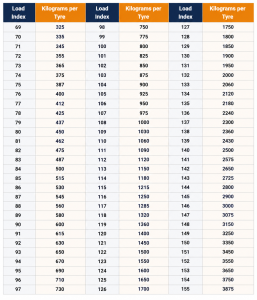
A truck tyre load rating, also called a load index, is a numerical code that shows the maximum weight a single tyre can carry under specified conditions. The number itself isn’t a weight in kilograms. It’s a code that corresponds to a fixed value on a standard load-index table.
For example, a load index of 154 corresponds to roughly 3,750kg per tyre. You can’t read the kilogram figure straight off the sidewall; you have to know what the code translates to.
How to Read Single and Dual Load Ratings
Two numbers before the speed rating mean two different load capacities, one for single fitment and one for dual fitment. Going back to our example:
315/70R22.5 154/150L
- 154 is the load index when the tyre is fitted as a single (one tyre per hub)
- 150 is the load index when the tyre is fitted as a dual (two tyres per hub, as you’d see on a drive axle)
- L is the speed rating
This matters because a dual-fitted tyre shares the load with its neighbour, so the rated capacity per tyre is lower than if it were running alone. If you’re checking whether a tyre suits your drive axle, you need the dual figure, not the single one.
Truck Tyre Load Rating Chart | Maximum Load per Tyre (kg)
How Much Weight Can a Truck Tyre Carry?
A tyre’s load rating and your truck’s legal carrying capacity are two different things, and confusing them is a common mistake. To work out real-world capacity, you need to factor in the load rating per tyre, how many tyres are on that axle, the axle’s own rated capacity, the vehicle manufacturer’s limits, and your GVM or GCM where relevant.
It’s also worth being clear on this: fitting a tyre with a higher load rating than your current one doesn’t automatically increase your truck’s legal payload or axle rating. The axle and chassis still set the ceiling. A higher-rated tyre gives you more margin and durability, but it doesn’t change what the law or the manufacturer allows you to carry.
How to Match Truck Tyre Size and Load Rating
Bringing it all together, here’s the process we walk customers through:
- Identify the approved tyre size by checking the sidewall and your manufacturer’s specifications.
- Check the required load rating to make sure the tyre can carry your axle’s load, in single or dual fitment.
- Confirm single or dual fitment and use the matching load index for that axle configuration.
- Consider the application. Front, steer, drive and trailer positions often call for different tyre designs, not just different sizes. Our guide to choosing the best steer tyres for trucks and buses goes into this in more depth.
- Check with a tyre professional if you’re unsure. Getting it wrong costs more than a phone call.
Get New or Used Truck Tyres in Perth from Wangara Tyre Auto
At Wangara Tyre Auto, you can get new or used truck tyres in Perth. Our team can help you identify the correct truck tyre for your vehicle, your load, and how you actually use it, whether that’s local deliveries around the metro area, interstate runs, or towing.
We also stock a wide range for cars, 4x4s and commercial vehicles, and we’re proud to be a trusted tyre shop in Wangara for truck tyres in Perth, servicing operators from Landsdale, Wangara and right across the northern suburbs. If you’d rather have someone check your fitment in person than work it out from a sidewall.
FAQs
What is the difference between truck tyre load index and ply rating?
Load index specifies a tyre’s rated carrying capacity, while ply rating (PR) indicates its strength or load-carrying classification. They describe different aspects of tyre performance.
Can I replace 315/80R22.5 truck tyres with 315/70R22.5?
Not automatically. Although both use a 315 mm width and 22.5-inch rim, their overall dimensions differ. Always check manufacturer-approved sizes before changing tyre specifications.
Can I use a higher load index on my truck tyres?
A higher load index may be suitable, but it doesn’t automatically make the tyre compatible. Check the approved tyre size, rim, axle requirements, speed rating and application first.
What is the difference between steer, drive and trailer truck tyres?
Steer tyres prioritise steering and stability, drive tyres focus on traction, while trailer tyres are designed for load carrying, stability and even wear.
What does 11R22.5 mean on a truck tyre?
11R22.5 means approximately 11-inch section width, radial construction and a 22.5-inch rim diameter. Unlike metric sizes, it doesn’t state an aspect ratio.